
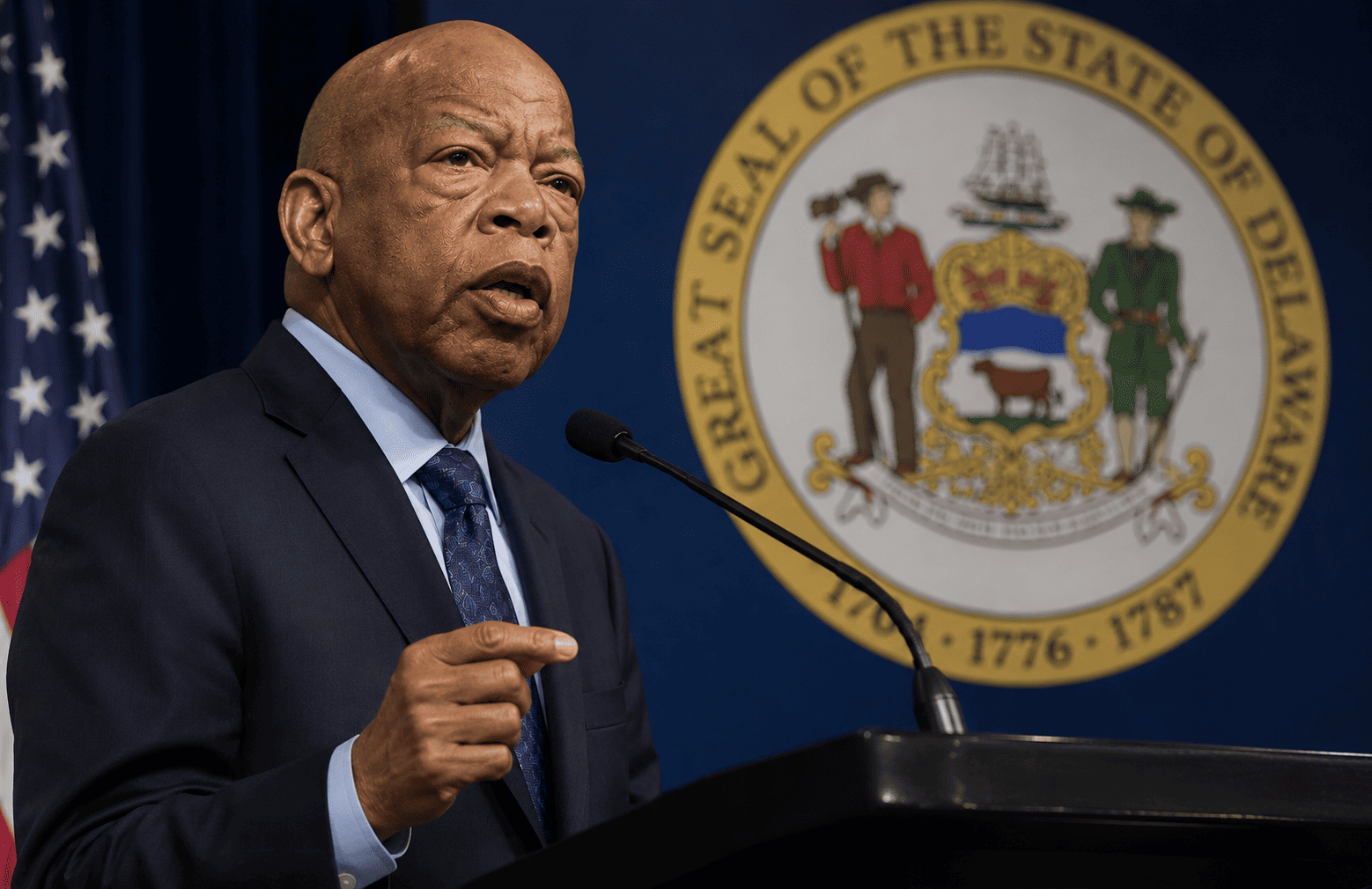
Delaware has enacted the Delaware John Lewis Voting Rights Act, establishing new state-level protections designed to safeguard voters from discrimination, voter suppression, vote dilution, intimidation and other barriers to participating in elections.
House Bill 444 was introduced by State Rep. Larry Lambert and named in honor of the late Congressman and civil rights icon John Lewis, who dedicated much of his life to securing and protecting voting rights for Black Americans. The legislation passed the Delaware House 29-11 before receiving a unanimous 21-0 vote in the State Senate.
The law establishes several protections within Delaware election law. It allows election policies or practices to be challenged when they result in prohibited voter suppression or dilution, strengthens protections against voter intimidation, deception and obstruction, and provides additional protections involving language access. It also gives the Delaware Attorney General authority to pursue certain voting-rights violations.
Importantly, the measure does not expand who is eligible to vote. Lambert previously explained that its purpose is to provide additional civil protections and ensure eligible Delaware voters have equal access to the political process.
The legislation comes as states have increasingly considered their own voting-rights protections following U.S. Supreme Court decisions that weakened portions of the federal Voting Rights Act. Delaware lawmakers and voting-rights advocates specifically pointed to the Supreme Court’s 2026 Louisiana v. Callais decision as a catalyst for HB 444.
The law is scheduled to take effect July 1, 2027, giving the Delaware Department of Elections time to prepare for new responsibilities, including language-access requirements and related regulations.
For Delaware, the legislation carries particular historical significance. John Lewis was one of the most prominent leaders of the Civil Rights Movement and was severely beaten while marching for voting rights across the Edmund Pettus Bridge in Selma, Alabama, on “Bloody Sunday” in 1965. The federal Voting Rights Act was signed into law later that year.
With Delaware’s new law bearing his name, Lewis’ legacy will now be permanently connected to the First State’s efforts to protect equal access to the ballot.