
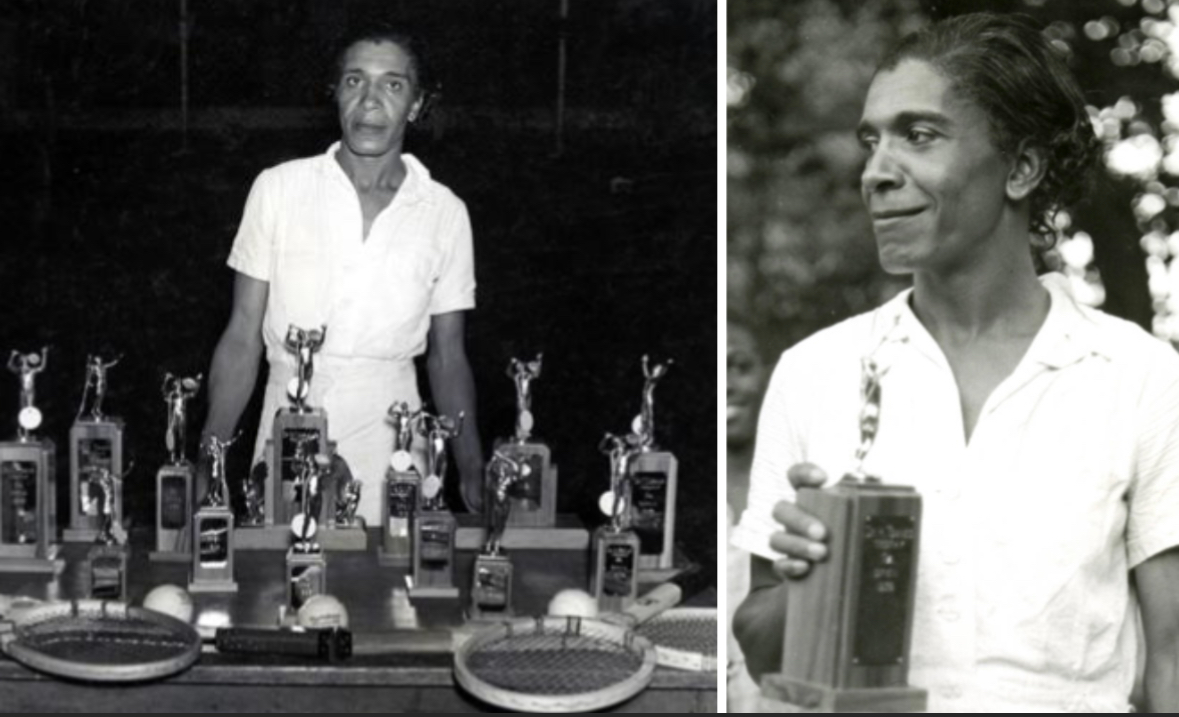
Long before Venus and Serena Williams changed the face of women’s tennis, there was Ora Washington, a pioneering Black athlete whose dominance in both tennis and basketball made her one of the greatest athletes of the early 20th century.
View this post on Instagram
Her story begins with a breakthrough victory at the Wilmington, Delaware Tennis Championships in 1924, continues with seven ATA National Tennis Titles, and reaches across the hardwood with 11 National Women’s Basketball Championships. Yet, despite these extraordinary achievements, Washington never received the recognition she deserved in her lifetime.
The Wilmington Breakthrough — 1924
In 1924, just months after picking up a tennis racket, Washington stunned the sports world by sweeping the Wilmington, Delaware Tennis Championships, winning singles, doubles, and mixed doubles.
This historic victory not only marked her emergence as a dominant force in tennis but also served as her gateway to the American Tennis Association (ATA), which provided competitive opportunities for Black athletes excluded from segregated white tournaments.
While records of her competing again in Wilmington in later years are incomplete, the 1924 triumph is widely recognized as the launchpad for her legendary career.
National Tennis Dominance
Building on her Wilmington success, Washington quickly became the star of the ATA circuit:
- In 1925, she won her first ATA national doubles title with partner Lula Ballard.
- From 1929–1935, she captured seven consecutive ATA women’s singles national titles, cementing her reign as the nation’s top Black female tennis player.
- She also collected numerous doubles and mixed doubles crowns, dominating the sport for nearly a decade.
Rivalry with the ‘Glamour Girl’ — Flora Lomax
Washington’s supremacy was so absolute that she briefly retired from singles play in the late 1930s. During her absence, Flora Lomax, often celebrated in the Black press as the “glamour girl of tennis,” rose to prominence.
Some observers speculated that Washington had stepped aside to avoid facing Lomax. Lomax’s style and flair contrasted sharply with Washington’s workmanlike, no-nonsense approach to the sport. Reports at the time suggested Lomax downplayed Washington’s abilities, implying her era had passed.
Stung by the remarks and eager to defend her legacy, Washington came out of retirement in 1939. At the ATA tournament in Buffalo, she defeated Lomax in a hard-fought match (6–2, 1–6, 6–2).
Washington later explained her return:
“Certain people said certain things last year. They said Ora was not so good any more. I had not planned to enter singles this year, but I just had to go up to Buffalo to prove somebody was wrong.”
This comeback not only silenced her critics but reaffirmed her standing as one of the greatest competitors of her time.
Basketball Supremacy in the Black Leagues
While she ruled the summer tennis courts, Washington also dominated winter basketball.
She first played for the Germantown Hornets, an all-Black women’s team, and later became the star of the Philadelphia Tribune Girls, a powerhouse squad in the segregated Women’s Colored Basketball League, part of the era’s broader Black Fives basketball movement.
With Washington as the leading scorer and often acting as coach on the floor, the Philadelphia Tribune Girls captured 11 straight Women’s Colored Basketball World Championships (1932–1942) — a feat unmatched in Black women’s sports history at the time.
Why She Was Overlooked
Despite her historic accomplishments, Washington remained largely unrecognized in mainstream sports during her lifetime due to overlapping barriers:
- Racial Segregation: Confined to segregated Black leagues and chronicled mainly by Black newspapers.
- Gender Bias: Women’s sports were undervalued, and Washington worked as a housekeeper even at her athletic peak.
- Unconventional Persona: Unlike Lomax, Washington avoided glamour and society circles, focusing solely on performance.
- Possible LGBTQ Prejudice: Some relatives and historians suggest that Washington faced additional bias for being gay, though evidence is limited.
A Legacy Finally Honored
In later decades, historians and sportswriters began to reclaim Washington’s story. Her achievements have been celebrated with induction into:
- The Black Athletes Hall of Fame (1976)
- The Women’s Basketball Hall of Fame (2009)
- The Naismith Memorial Basketball Hall of Fame (2018)
Tennis legend Arthur Ashe once called her one of the greatest female athletes in history. Today, her life is the subject of books, podcasts, and renewed recognition in both sports.
The Original ‘Queen of the Courts’
Ora Washington’s journey, from her breakthrough at the Wilmington Tennis Championships in 1924, to seven ATA National Tennis Titles, to 11 basketball championships, and finally to her dramatic comeback to defeat the “glamour girl” Flora Lomax, reflects unmatched skill, determination, and courage.
Long before mainstream society acknowledged her greatness, Washington broke barriers and excelled across two sports, proving that true champions need neither glamour nor fanfare to leave an enduring mark.